State of the AI Market in 2026: Agents, Ads, and the $2 Trillion Surge
What Is the State of the AI Market in 2026? The global AI market in 2026 has crossed the $2 trillion spending threshold, according to Gartner estim
What Is the State of the AI Market in 2026?
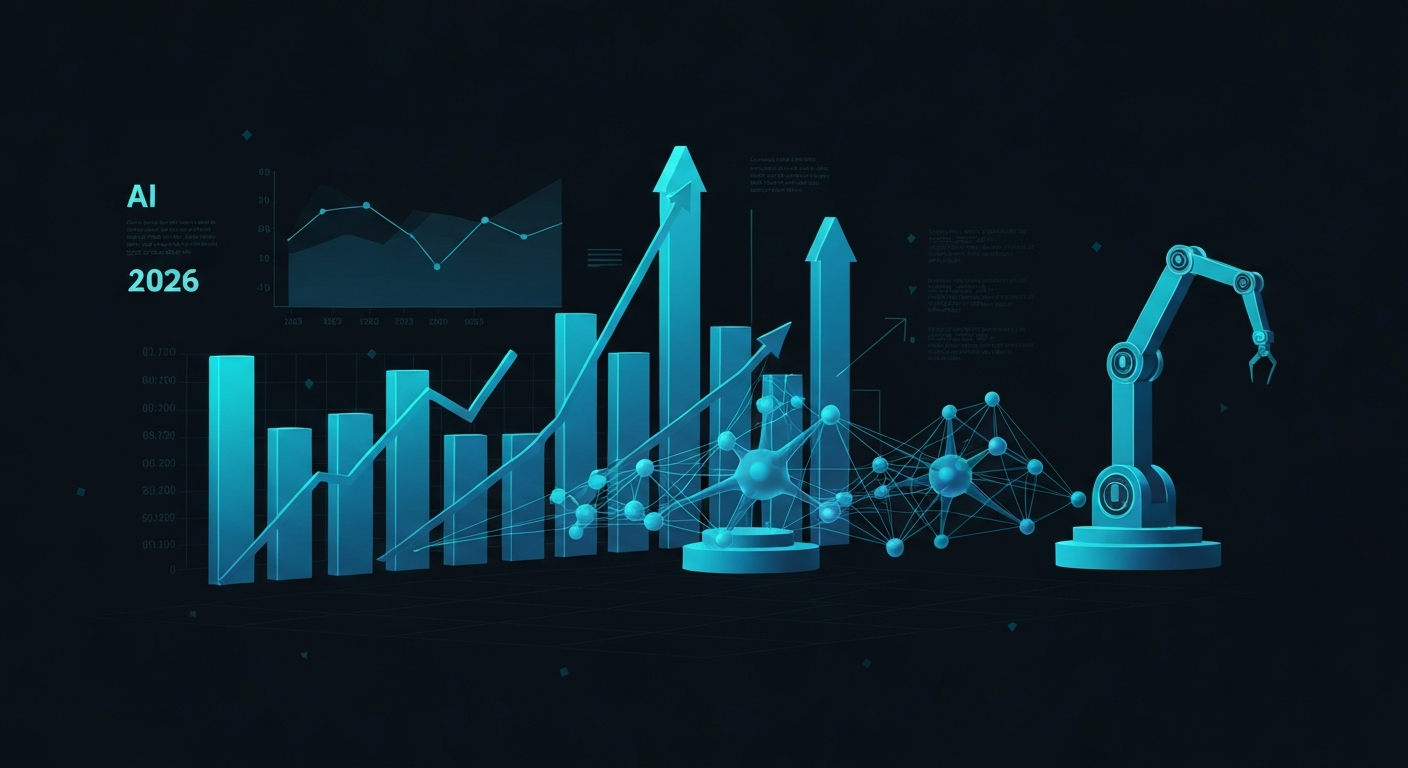
The global AI market in 2026 has crossed the $2 trillion spending threshold, according to Gartner estimates, marking the transition from experimental technology to mission-critical enterprise infrastructure. AI agents, physical AI, and advertising inside AI chatbots are reshaping the competitive landscape across every industry.
This analysis breaks down the key trends, market data, and strategic implications shaping the AI industry in February 2026 — from the rise of agentic AI to the growing tension between innovation speed and governance readiness.
How Big Is the AI Market in 2026?
Global AI spending is projected to exceed $2 trillion in 2026, up from nearly $1.5 trillion in 2025, according to Gartner. The compound annual growth rate sits at approximately 22%, with total spending expected to reach $3.3 trillion by 2029. This makes AI the fastest-growing enterprise technology category in history.
| Year | Estimated Global AI Spending | Growth Driver |
|---|---|---|
| 2025 | ~$1.5 trillion | GenAI rollouts, cloud AI services |
| 2026 | $2+ trillion | Agentic AI, enterprise deployment |
| 2029 | $3.3 trillion (projected) | Physical AI, autonomous systems |
The spending increase is driven by three factors: enterprises moving from AI pilots to production deployments, the buildout of gigawatt-scale compute clusters coming online in early 2026, and the rapid adoption of AI agents across business functions.
What Are AI Agents and Why Are They Dominating 2026?
AI agents are autonomous software systems that can plan, execute, and iterate on multi-step tasks without continuous human input. The AI agents market is estimated at $7.63 billion in 2026 and is projected to reach $50.31 billion by 2030, according to DemandSage research. Gartner projects that 40% of enterprise applications will include task-specific AI agents by the end of 2026.
The agent paradigm represents the biggest shift in how businesses deploy AI since the launch of ChatGPT in late 2022. Instead of humans prompting a chatbot for one-off answers, agents handle entire workflows: customer support ticket resolution, code deployment pipelines, financial report generation, and supply chain optimization.
Key AI Agent Statistics for 2026
- Market size: $7.63 billion in 2026, growing to $50.31 billion by 2030
- Enterprise adoption: Approximately 85% of enterprises are expected to have implemented AI agents
- Application integration: 40% of enterprise apps will include task-specific agents by end of 2026 (Gartner)
- GDP impact: Generative AI is expected to contribute $2.6 to $4.4 trillion annually to global GDP by 2030
However, there is a critical nuance. MIT Sloan Management Review notes that AI agents are entering the Gartner "trough of disillusionment" in 2026 — the same phase generative AI itself recently passed through. Early adopters are discovering that autonomous agents require significant guardrails, monitoring infrastructure, and human oversight to operate reliably in production.
Is ChatGPT Getting Ads? What It Means for AI Search
Yes. OpenAI began rolling out advertising in ChatGPT in February 2026, marking a pivotal shift in the AI industry's business model. This forces users to distinguish between organic AI recommendations and sponsored content, fundamentally changing the trust dynamics of AI-powered search.
The implications are significant for businesses and marketers:
- AI search advertising is now a real channel — companies can pay for placement in AI-generated answers
- Trust calibration becomes critical as users learn to evaluate sponsored vs. organic AI responses
- Answer Engine Optimization (AEO) grows more important as organic visibility in AI engines becomes competitive
- First-mover advantage exists for advertisers entering the ChatGPT ad ecosystem early
With ChatGPT reaching over 800 million weekly active users and 58-60% of Google searches resulting in zero clicks, the shift toward AI engines as primary information sources is accelerating. Businesses that optimize for AI citation — not just Google ranking — will capture disproportionate value.
How Is Physical AI and Robotics Changing the Landscape?
Physical AI — the integration of advanced AI into robots, autonomous vehicles, and industrial systems — is emerging as the next major growth frontier. The AI-powered industrial robot market is valued at $17.9 billion in 2026 and projected to reach $33.3 billion by 2035, at a CAGR of 7.1%, according to Global Market Insights.
IBM highlights that "robotics and physical AI are definitely going to pick up" in 2026, as the industry recognizes that large language models alone are hitting diminishing returns from pure scaling. The frontier is moving from text-based AI to multimodal systems that perceive and act in the physical world.
Where Physical AI Is Being Deployed
- Manufacturing: AI-powered quality inspection, predictive maintenance, and autonomous assembly lines
- Logistics: Warehouse robotics, autonomous delivery vehicles, and supply chain optimization
- Healthcare: Surgical robotics, AI-assisted diagnostics, and automated lab analysis
- Agriculture: Precision farming robots, drone-based crop monitoring, and automated harvesting
What Should Enterprises Watch Out For in 2026?
The biggest risk in 2026 is the gap between AI investment speed and governance readiness. Wolters Kluwer and Verdantix warn that rapid innovation and aggressive spending will collide with cybersecurity exposure, governance constraints, and concerns about an AI market correction.
Key risks and watchpoints for enterprise leaders:
- Agent reliability: Autonomous AI agents can fail silently — enterprises need monitoring and human-in-the-loop safeguards
- Governance gaps: Regulatory frameworks lag behind deployment speed, especially for agentic AI
- Market correction risk: Some analysts warn of overinvestment in AI capabilities that haven't proven ROI
- Cybersecurity exposure: AI systems expand the attack surface — adversarial attacks on agents are a growing threat
- Talent shortage: Demand for AI engineers and ML operations specialists far outpaces supply
How Is AI Spending Distributed by Region?
North America dominates global AI spending, driven by enterprise-scale budgets, mature cloud infrastructure, and a dense AI vendor ecosystem. However, the Middle East and Asia-Pacific regions are among the fastest-growing AI markets, with government-backed AI strategies accelerating adoption.
| Region | AI Market Position | Key Drivers |
|---|---|---|
| North America | Largest market share | Enterprise budgets, cloud maturity, AI vendor density |
| Asia-Pacific | Fastest absolute growth | Government AI programs, manufacturing AI, mobile-first adoption |
| Europe | Regulation-forward | EU AI Act compliance, ethical AI focus, industrial automation |
| Middle East | Fastest strategic growth | National AI strategies (UAE, Saudi Arabia), sovereign AI investment |
For businesses in the MENA region, 2026 represents a critical window. The UAE's national AI strategy and Saudi Arabia's Vision 2030 are driving billions in AI infrastructure investment, creating opportunities for companies that can deliver AI implementation expertise at enterprise scale.
What Are the 5 Defining AI Trends of 2026?
Based on analysis from Gartner, IBM, MIT Sloan, and current market data, these are the five trends defining the AI industry in 2026:
- Agentic AI goes mainstream — 40% of enterprise apps will include AI agents by year-end, though the trough of disillusionment will filter out weak implementations
- AI advertising emerges — ChatGPT ads and AI search monetization create a new marketing channel worth billions
- Physical AI accelerates — Robotics and embodied AI move from labs to production, with the industrial robot AI market at $17.9 billion
- Governance becomes urgent — The gap between AI capability and regulatory framework reaches a tipping point
- Compute infrastructure scales up — Gigawatt-scale data centers come online, ending the compute scarcity era for frontier models
Frequently Asked Questions
How much is being spent on AI globally in 2026?
According to Gartner estimates, global AI spending will exceed $2 trillion in 2026, up from approximately $1.5 trillion in 2025. The market is growing at a compound annual growth rate of about 22% and is projected to reach $3.3 trillion by 2029.
What is agentic AI and why does it matter?
Agentic AI refers to autonomous AI systems that can plan, execute, and iterate on complex multi-step tasks without continuous human input. The AI agents market is estimated at $7.63 billion in 2026. Gartner projects that 40% of enterprise applications will include task-specific AI agents by the end of 2026.
Is OpenAI putting ads in ChatGPT?
Yes. OpenAI began rolling out advertisements in ChatGPT in February 2026. This represents a major shift in AI business models and means users now need to distinguish between organic and sponsored AI recommendations.
Which industries are adopting AI fastest in 2026?
Technology, financial services, healthcare, and manufacturing lead AI adoption in 2026. The AI-powered industrial robot market alone is valued at $17.9 billion. Approximately 85% of enterprises across all sectors are expected to have implemented some form of AI agents.
What risks should businesses consider with AI in 2026?
Key risks include governance gaps, agent reliability failures, cybersecurity exposure from expanded AI attack surfaces, potential market correction from overinvestment, and a persistent talent shortage in AI engineering and ML operations roles.
Written by
Optijara AI